
Biometric Re-authentication
Log users back in with a selfie.
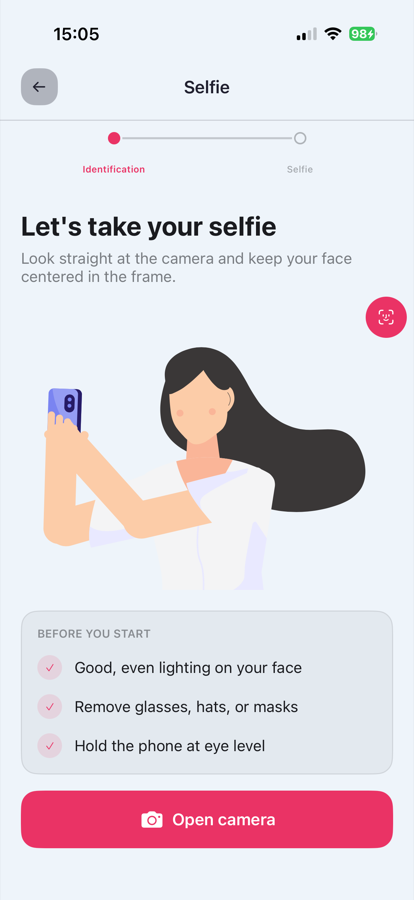
You verified them once - stop making them prove it with passwords. Re-authentication matches a liveness-checked selfie against the biometric enrolled at onboarding, turning login, step-up and account recovery into a one-second glance.
Capabilities
What Biometric Re-authentication gives you.
Selfie-only login
Returning users authenticate with a face - no passwords, no OTPs, no SMS costs.
Step-up authentication
Trigger a face check on sensitive actions: payouts, limit changes, new payees, data exports.
Account recovery
Recover locked accounts with biometric proof instead of phishable email links and security questions.
Liveness on every attempt
Each re-auth runs full deepfake and replay defence, so a photo of the owner never unlocks anything.
Identity-bound, not device-bound
Works on any device - the match is to the verified identity, so a new phone isn’t a lockout.
Session risk signals
Device and IP context accompany every attempt for your risk engine.
From session to signed result.
Four steps - the same integration pattern as every Amani module.
Create a session
One API call (or a Studio journey) starts a verification session for this module.
User completes the flow
Your customer is guided through capture in your branded UI - web or mobile.
Checks run in real time
Biometric Re-authentication executes alongside any other modules in the journey.
You receive a signed result
A webhook delivers the decision, scores and evidence to your backend.
For developers
Integrate Biometric Re-authentication.
Authenticate, create a profile, generate a verification URL - then let Amani handle the rest. Or describe what you want to your AI coding agent and let Amani Skills wire it up from the live docs.
Available on
verify.sh
# 1 · Authenticate (server-side only)
curl -X POST 'https://ae.amani.ai/api/v2/user/login/' \
  --form 'username="you@company.com"' \
  --form 'password="••••••••"'

# 2 · Create the customer profile
curl -X POST 'https://ae.amani.ai/api/v2/profile' \
  -H 'Authorization: Bearer $ACCESS_TOKEN' \
  --form 'id_card_number="784199012345678"' \
  --form 'name="Layla Haddad"'

# 3 · Generate the verification URL
curl -X POST 'https://ae.amani.ai/api/v2/profile/url' \
  -H 'Authorization: Bearer $ACCESS_TOKEN' \
  -H 'Content-Type: application/json' \
  --data '{
    "profile": PROFILE_ID,
    "web_sdk_url": "https://verify.amani.ai",
    "language": "en",
    "return_url": "https://yourapp.com/verified"
  }'

# Biometric Re-authentication runs inside this session - configure it in Amani Studio.
with Amani Skills
# Install Amani Skills once
npx -y github:AMANI-AI-ORG/skills --global

# Then ask your coding agent:

You › Before a high-value withdrawal, add an Amani BioMatch face check on iOS to confirm the account owner.

# The matching skill fetches the live docs, pins the
# current SDK version and wires up the integration -
# secrets left as placeholders. Claude Code, Cursor and
# any Agent-Skills-compatible tool.
webhooks.ts
// Amani signs every webhook with an HMAC signature using
// your secret. Always verify it before processing.
import crypto from 'node:crypto';

app.post('/webhooks/amani', (req, res) => {
  // Confirm the exact header name in the Webhooks API reference.
  const signature = req.get('X-Amani-Signature') ?? '';

  const expected = crypto
    .createHmac('sha256', process.env.AMANI_WEBHOOK_SECRET)
    .update(req.rawBody)
    .digest('hex');

  const valid =
    signature.length === expected.length &&
    crypto.timingSafeEqual(Buffer.from(signature), Buffer.from(expected));

  if (!valid) return res.status(401).end();

  const { profile, status } = req.body;
  if (status === 'approved') activateAccount(profile);

  res.status(200).end();
});
Biometric Re-authentication - common questions
How is this different from Face ID?
Device biometrics unlock a device and stay on it. Amani re-authentication proves the verified account owner is present - on any device, bound to the KYC identity.
When should I trigger re-authentication?
Most customers use it at login for high-risk products, and as step-up on sensitive actions like withdrawals, payee changes and recovery.
What if a user’s appearance changes?
Templates tolerate normal changes (glasses, facial hair, ageing). Genuine failures fall back to your configured recovery path - typically a fresh document check.
Related modules
Add Biometric Re-authentication to your flow
Switch it on in Amani Studio, or call it directly from the API.